


A fountain pump upgrade fixes weak flow only when the pump itself is the limit, and a bucket and a stopwatch will tell you which. The steps run in order: measure your fountain's real lift height, test what your current pump actually delivers, rule out the free fixes at the intake, dial, and tubing, then size a replacement to the fountain you already own.
A three-tier cast stone fountain can look fine from the kitchen window and still sound wrong from the patio. The top bowl sheets nicely, the middle tier spills in a thin ribbon, and the bottom basin barely ripples. The splash you bought it for comes through as a trickle. Sometimes that's the pump. Often it isn't.
The flow rate on the pump box is measured at almost no height
A fountain pump's advertised flow rate only means something once you read it at your fountain's height. Flow is counted in gallons per hour, or GPH. Some pumps list gallons per minute instead, and if you're shopping for a higher GPM pump for a tiered fountain, the conversion is one line: GPM × 60 = GPH, so a 4 GPM pump moves 240 GPH.
That GPH figure shrinks as the pump lifts water higher. Fountain Tech's published figures for its FT-1250 show about 1,150 GPH at 20 inches of lift and about 400 GPH at 120 inches. Same pump, roughly a third of the water. The Pond Pump Team blog makes the same point from another direction, noting that flow "depends more on head height, tubing resistance, and suction efficiency" than on raw pressure. Long runs of narrow tubing and every 90-degree elbow add resistance a tape measure can't see.
Max head is the height where the water stops moving. Your fountain needs to run well below it.
The biggest number on the box is the least useful one, and comparing two pumps by their headline GPH is how people end up buying the wrong one.
Measure from the water surface to the highest outlet
Grab a tape measure before you look at any spec sheet. On a tiered fountain, measure from the waterline in the bottom basin straight up to the outlet at the top bowl, where the water first comes out. Write that number down. You'll use it to read a pump chart, to judge your bucket test, and to choose a replacement.
The pump that ships with a fountain is matched to a typical setup: the fountain on level ground, a short tubing run, and the tiers it was designed with. Set the fountain on a raised pad, run the tubing farther, add a tier, or widen a spillway, and the math changes. The original pump is then lifting more than it was sized for, and the top bowl shows it first.
A bucket and a stopwatch tell you whether a new pump will improve performance

A bucket test tells you whether a new pump will improve performance, and the math is gallons ÷ seconds × 3,600 = GPH. If you're working out how to upgrade your fountain pump for better flow and performance, start here, because this is the one measurement that includes your real lift.
Mark a bucket at a known volume. Pull the tubing off the outlet at the top bowl, or hold its end at that same height, and let it run into the bucket while someone times it. Catching the water at the top matters. A reading taken down at the basin skips the lift and flatters the pump.
Say the 5-gallon mark fills in 75 seconds. Five divided by 75 is about 0.067 gallons per second, and multiplied by 3,600 that's 240 GPH.
Now find the chart for your pump, which is usually printed on the box, in the manual, or on the manufacturer's product page, and look up the flow it should deliver at the height you measured. If your bucket number is far below that figure, the pump is probably healthy and something in the system is choking it. That's good news, because those fixes are mostly free. If your bucket number roughly matches the chart and the fountain still looks thin, the pump is doing everything it was built to do. It's undersized for this fountain at this height, and that's when an upgrade pays off. Most guides mention the bucket test and stop there, but the comparison against the chart is what turns it into a decision.
We'd rather you spend two minutes with a bucket than fifty dollars on a pump that changes nothing.
Why your fountain isn't flowing strongly when the pump checks out
A fountain that isn't flowing strongly while the pump checks out usually has a restriction somewhere between the intake and the top bowl. We hear this one on the phone a few weeks after a fountain goes in: it isn't doing what it did in the picture.
The first thing we ask about is the pre-filter sponge, because leaves, pollen, and algae pack into it faster than most owners expect. Next is the flow dial on the pump, which gets bumped toward low during a cleaning more often than you'd think. Then we ask about the tubing. A kink where it bends up into the riser, or a fitting that slipped halfway off the outlet and is leaking back into the basin, will cut the flow to the top bowl while the pump runs perfectly well.
If those look right, we ask whether the basin was just refilled. Air trapped in the line can leave a pump spinning without pushing much water, and tilting the pump under the surface to let the bubbles escape usually clears it. After that come the slower causes. Algae can coat the inside of the tubing and narrow it over a season. Calcium scale builds on the impeller and slows it down. A long, light-gauge extension cord can starve the pump of voltage, so it runs but never reaches full speed.
Cleaning tells you which problem you have. Weak flow that comes back after you rinse the sponge and clear the impeller points to a clog. A pump that hums without moving water, runs in fits and starts, or feels hot after a thorough cleaning points to impeller or motor wear, and that pump is near the end of its life.
One more pattern is worth knowing. If water sheets off one side of a bowl and barely wets the other, that's a level problem, and a bigger pump will only push more water off the low side.
A clogged sponge or a bumped dial explains more weak fountains than any undersized pump. Rule those out before you buy anything.
Wider tubing and fewer elbows are the cheapest flow upgrade there is
Wider tubing and fewer elbows can add real flow from the same pump on the same electricity. John G Modern Design showed this on a pond build in his Water Feature Design Series on YouTube. With a 35-foot run and 10 feet of lift, swapping 2-inch pipe for 3-inch took the system from about 2,500 to "almost 4,000 gallons per hour," which he described as "60% more flow out of the same pump for the same electricity." He also counts each 90-degree elbow as adding about a foot of head. The idea behind both numbers is total dynamic head: your lift plus a friction allowance for every foot of pipe and every bend. His elbow figure comes from a larger-pipe build, so treat it as a rough allowance on a garden fountain.
Garden fountain tubing usually comes in 3/8, 1/2, and 3/4 inch sizes. Stepping up from 3/8 to 1/2 or 3/4 inch where the pump outlet and the fountain's riser allow it, shortening the run, and removing bends you don't need all cut resistance between the pump and the top bowl.
We can't give you a fountain-scale percentage, because it depends on your run. Tubing is often the first thing we'd change, though. There's no margin in a few feet of wider hose, which is why nobody sells it to you as an upgrade.
Sizing a fountain pump upgrade to the height of the fountain you own

A fountain pump upgrade should be sized to the flow you want at your fountain's measured height, with max head as a sanity check. Published size charts disagree because they measure different things. One convention lists the flow a pump delivers at the fountain's height. Another, from a widely shared outdoor fountain sizing guide, says a pump's max head should be "at least 1.5 times" the fountain height, so a 4-foot fountain needs at least 6 feet of max head. Use the first to choose and the second to check. That same guide offers these starting points:
- Tabletop fountains and shallow bird baths (0 to 18 inches): about 50 to 130 GPH, 2.5 to 3 feet of max head
- Medium tiered fountains (18 to 36 inches): about 150 to 250 GPH, 5 to 6 feet of max head
- Large classic fountains (36 to 60 inches): about 300 to 600 GPH, 8 to 10 feet of max head
- Waterfalls and ponds (60 inches and up): about 800 to 1,200+ GPH, 12 to 15+ feet of max head
Tiered cast stone fountains from Campania International, Henri Studio, and Massarelli lift water from the bottom basin all the way to the top bowl, so the top bowl is your measuring point no matter how wide the basin is. If you browse our collection of tiered outdoor fountains, you'll see how much those heights vary from one model to the next. Wall and sheet fountains need more flow as the spillway gets wider, because the water has to cover the whole lip to sheet evenly. Charts are a starting point, and the fountain's real top-outlet height decides it.
When a pond outgrows any fountain pump, you're shopping for an aerating or display unit from AquaMaster or EasyPro instead. Our collection of lake and pond fountains is where that conversation starts.
More power costs you in splash, refills, and noise
A more powerful fountain pump costs you in splash, refills, and noise. More flow means a fuller sheet off the top bowl, and more water lost to splash and wind past the basin edge. The same sizing guide warns that 400 GPH "will violently blast" a shallow bird bath dry "in a few hours." A bigger pump is louder too, in the motor hum and in water landing harder on the bowl below. The real danger is a basin that runs low, because the guide also notes a submersible pump run dry can be destroyed "within 10 minutes." A built-in flow dial is fine for fine-tuning a pump that's close to right. Buying double the pump and planning to throttle it down pays for capacity you'll never use, even though diverter tees and speed controllers exist for the job. A City of Los Angeles newsletter on pump efficiency notes that variable-speed savings "only apply to circulating pump systems, not systems with high static heads," and a fountain is mostly lift.
In Florida summer heat, evaporation and splash can drop a basin faster than you'd guess. That's why low-water shut-off stops being optional the moment you upsize. It adds to the price of the pump, and it costs less than replacing a burned-out one.
What a pump costs to run, worked out against your own power bill
A fountain pump's running cost comes from its wattage: watts × 24 × 30 ÷ 1,000 = kWh per month of round-the-clock use. Fountain Tech lists its FT-650 at 70 watts, which works out to 50.4 kWh a month, and its FT-70 at about 2.5 watts, or 1.8 kWh. Multiply your result by the rate printed on your utility bill.
Submersible, external, or solar: which pump setup fits your fountain
A submersible pump fits nearly every garden fountain, an external pump fits larger systems, and solar is a separate conversation.
Submersible or external? A submersible pump for a fountain sits underwater in the basin, out of sight, and it's the default for tiered, wall, and statuary and figurine fountains. External pumps sit outside the water and belong to bigger systems with longer plumbing runs.
Which type of pump? Blue Thumb Fountains, a brand we carry, publishes three main types: mag-drive pumps with a 5-year warranty, solids-handling pumps that pass debris "up to 1.25 inches," and IllumiFlow pumps with a 24-month warranty. Efficient pumps want clean water. Solids-handling pumps resist clogs and draw more power to do it.
Can solar do the job? Solar flow is capped by the panel and the sun, so a bigger pump on the same panel won't fix weak solar flow. Call us before you buy anything for a solar fountain.
Six things to check on a replacement pump before the old one comes out
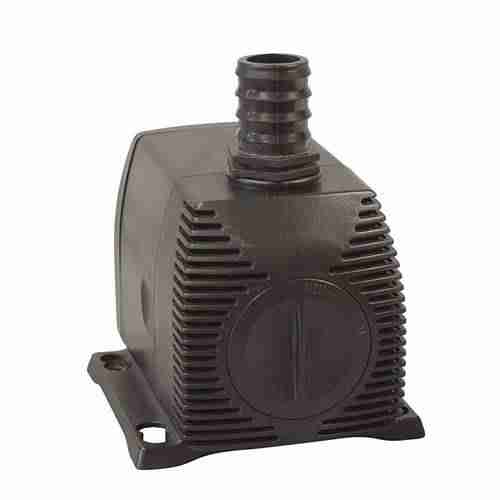
A replacement pump has to fit the fountain you already own, so check these six points before ordering anything.
- Rated flow at your measured height, not the box maximum
- Outlet size and adapters that match your tubing (3/8, 1/2, or 3/4 inch)
- Physical fit in the basin or reservoir, with the intake fully submerged
- Cord length and routing through the fountain's existing cord hole
- Low-water shut-off, if you're upsizing or the basin is shallow
- The water type it's rated for, fresh or chlorinated
The label on your old pump is the most useful thing you can send us. Text a photo of it along with a photo of the fountain and the height you measured, and we'll match a pump to that specific model. With 29 years of hands-on installation behind us, we size from the fountain first and use the chart as a check. Tubing adapters, fittings, and spare parts are in our fountain accessories collection.
Clean intakes and full basins decide how long a fountain pump lasts
A fountain pump lasts longest with a clean intake and a basin that never runs low. Rinse the pre-filter sponge and clear the intake whenever flow at the top bowl starts to thin. Top up the basin for evaporation, more often in hot or windy weather. Every few months, pull the pump and look at the impeller for scale, since a gritty white coating there slows it down long before the motor wears out.
Freezing climates change the routine. A fountain can sit through Canadian ice, but the pump should come out before the first hard freeze and be stored indoors.
For planning, treat the manufacturer's warranty as your horizon. Published warranties such as Blue Thumb's run roughly 2 to 5 years, and a well-kept pump can outlast its warranty. Pumps rarely die of old age first. They die of a clogged intake or a basin left to run low, so the sponge is the place to start.
Other pump questions owners ask us
These three come up on the phone often enough to answer here.
Should a fountain pump run all day and night?
Running a fountain pump around the clock is fine as long as the basin stays full. Watts × 720 ÷ 1,000 gives you the monthly kWh, so you can see the cost on your own bill. Shut it off before a freeze or when you'll be away and can't top up.
Where should the pump sit in the basin?
Set the pump fully submerged, level, and close to the riser that feeds the top outlet. Keep the intake up off the basin floor where debris settles, and route the cord out through the fountain's existing cord hole.
Why does my new pump keep stopping and starting?
Usually the low-water shut-off is sensing a low basin and cutting power until the level recovers. Air trapped after a refill can cause the same stutter, so top up, tilt the pump underwater to release the bubbles, and send us a photo if it keeps cycling.
Text us three things and we'll tell you if the pump is the problem
Text us three things and we'll tell you whether the pump is the problem: a photo of the fountain, a photo of the label on the pump, and the height you measured from the waterline to the top outlet. From those, we can usually tell whether you're looking at a cleaning job, a tubing change, or a pump matched to that model. Sometimes the answer is that you don't need anything, and we'll tell you that too. Text (502) 298-7752 or call (941) 256-0152.