Shoreline plants
A planted shoreline filters runoff, holds the bank and gives fish cover. UF/IFAS lists Florida-friendly plants for each part of a stormwater pond shoreline (UF/IFAS EP476).
Best for: bare banks and new or rebuilt shorelines.

Have an account? Log in to check out faster.


Lake & pond resource center
The short answer
Most of what ends up in a lake washes in from the land around it. Keep a low-maintenance zone at least 10 feet wide along the water, with no mowing, fertilizer or pesticides (UF/IFAS). Keep grass clippings and yard waste out of drains and the water, and repair eroded slopes early. In most Florida neighborhoods the HOA or CDD maintains the stormwater pond under its permit (SWFWMD), so check the permit before you change the shoreline.
Most shoreline care is planning and upkeep, not products. Start with these Florida guides, then add the tools that fit your lake.
A planted shoreline filters runoff, holds the bank and gives fish cover. UF/IFAS lists Florida-friendly plants for each part of a stormwater pond shoreline (UF/IFAS EP476).
Best for: bare banks and new or rebuilt shorelines.
UF/IFAS recommends a zone at least 10 feet wide along the water where you do not mow, fertilize or use pesticides. It means less mowing and protects the water (UF/IFAS).
Best for: lawns and common areas that run down to the water.
Your water management district explains who maintains a neighborhood pond and what residents should and should not do around it (SWFWMD).
Best for: HOA and CDD boards and property managers.
Repairing eroded slopes is part of regular stormwater pond upkeep (SWFWMD). Our licensed lake management partners can assess the bank and recommend a repair.
Best for: undercut banks, washouts and slumping slopes.
A circulator is a motor and propeller that keeps water moving at docks, seawalls and canals and pushes floating debris away from the shore. Ask us about Kasco AquatiClear circulators.
Best for: docks, seawalls and canals with floating debris.
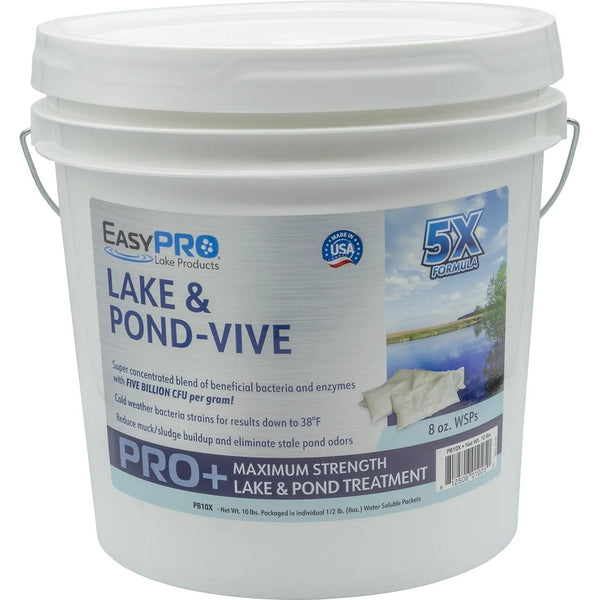
Runoff leaves sediment and other pollutants on the pond bottom, and extra nutrients can feed algal blooms (SJRWMD). EasyPro Muck & Sludge Remover and Lake & Pond-Vive bacteria help break down the organic waste.
Best for: ponds with muck on the bottom.
A neighborhood lake or stormwater pond collects the rain that runs off roads, sidewalks and lawns. Sediment and other pollutants settle to the bottom of the pond instead of flowing on to natural waterways (SJRWMD). That is the pond doing its job, but the extra nutrients it collects can feed algal blooms (SJRWMD).
FWC notes that ponds near septic drain fields, fertilized lawns and other nutrient sources are often overloaded with nutrients (FWC). Grass clippings matter too: SWFWMD warns that clippings in the water increase oxygen demand and can harm fish (SWFWMD).
So shoreline care starts on land: what goes on the lawn, where the clippings go and what grows along the edge.
Most Florida neighborhood ponds are permitted stormwater systems. After construction, the permit and the legal responsibility for maintenance typically pass to the homeowners, condominium or property owners association (SWFWMD). In some communities a community development district (CDD) maintains them instead (SWFWMD).
SWFWMD notes that this responsibility applies to every owner in the neighborhood, not only the homes that back up to the pond. The permit sets the exact requirements, so read it before you change the pond or its shoreline (SWFWMD).
Regular upkeep includes clearing the inflow and outflow structures, removing nuisance and excess vegetation, repairing eroded slopes and picking up trash and yard waste near storm drains (SWFWMD). SJRWMD adds that the HOA or management company should check every control structure and remove debris before hurricane season (SJRWMD).
These come straight from Florida's guidance for homeowners and HOAs.
For fishing ponds, FWC suggests no fertilizer within 20 feet of the water (FWC). Your city or county may also set its own fertilizer rules and buffer requirements, so check local codes (UF/IFAS).
Shoreline plants are not decoration. Many stormwater ponds are designed and required to have native aquatic plants. They filter polluted runoff, trap sediment and help control nuisance vegetation, and they give fish cover and nursery areas (SWFWMD).
UF/IFAS adds that strongly rooted plants at the water's edge help prevent erosion by buffering the wave action that undermines the bank, and that a planted buffer keeps fertilizer runoff and grass clippings out of the pond. Plants set in the water must be native under Florida rules (UF/IFAS EP476).
| Plant | Where it grows | Water depth | Height |
|---|---|---|---|
| Pickerelweed | Water's edge | 6 to 18 inches | 3 feet |
| Duck potato | Water's edge | 6 to 12 inches | 3 feet |
| Arrowhead | Water's edge | 6 to 12 inches | 3.5 feet |
| Golden canna | Water's edge | 12 to 18 inches | 3 feet |
| Spikerush | Water's edge | 6 to 12 inches | 2.5 feet |
| Blue flag iris | Water's edge | Moist to wet soil | 2 feet |
| Sand cord grass | Water's edge | Dry to wet soil | 4 feet |
| Muhly grass | Bank slope | Dry to wet soil | 3 feet |
| Blue mistflower | Bank slope | Moist soil | 2 feet |
From UF/IFAS EP476, Florida-Friendly Plants for Stormwater Pond Shorelines (UF/IFAS EP476). UF/IFAS suggests checking the average water level along the shoreline each year before you plant.
Grass on the slopes of a pond holds the soil and filters sediment (SWFWMD), and a narrow band of shoreline plants protects the bank from erosion (FWC). Where the bank is bare, waves and runoff wear it away.
Repairing eroded slopes is part of regular pond maintenance (SWFWMD). Plants are harder to establish on steep slopes, and UF/IFAS suggests mini-baffles, landscape fabric or riprap to hold the soil while they take root (UF/IFAS EP476). Fountains can add to bank erosion too, so placement matters (UF/IFAS SS695).
Bank repair is field work. Our licensed lake management partners can assess the erosion and recommend a fix. In a permitted stormwater pond, check the permit before any construction (SWFWMD).
Most shoreline care is planning and upkeep. These Florida guides cover what boards and homeowners need to know.
Contact us for your particular needs. We suggest a comprehensive plan to address all of them. Our team provides pricing for the services and materials & equipment if needed. Then our licensed lake management partners perform any field work necessary to complete the plan, unless you want to perform it yourself.
Removing exotic, nuisance and excess vegetation is allowed. Before you remove a significant amount, check with your association or CDD and your water management district. SWFWMD recommends selective removal by hand rather than mass removal of native plants (SWFWMD).
Strongly rooted plants at the water's edge, such as pickerelweed, duck potato, arrowhead and spikerush, buffer the waves that wear the bank away. Muhly grass and blue mistflower suit the slope above (UF/IFAS EP476). Plants set in the water must be native.
Repair eroded slopes early, as part of regular upkeep (SWFWMD). On steep slopes, mini-baffles, landscape fabric or riprap hold the soil while new plants take root (UF/IFAS EP476). Our licensed partners can assess the bank. Check your permit before any construction.
SWFWMD does not recommend it. Recreational use of stormwater ponds is potentially hazardous to your health (SWFWMD).
Last reviewed November 2026. General information, not legal advice. Follow each product label, and confirm the rules with your state agency, water management district or county.
Lake and pond assessment
Tell us about the shoreline: erosion, bare banks, runoff or floating debris. Add a few photos if you can. We will help you plan the fix.